




#How demander un devis de composant électronique : Meilleures pratiques de demande de renseignements
Envoyer une demande d’offres vague vous coûte trois jours dans les e-mails de clarification, gonfle les devis de 15 à 30 % à cause de l’augmentation des risques du fournisseur, et aboutit souvent à des devis que vous ne pouvez pas comparer. Les équipes d’achats gérant des MAM de plusieurs milliers de lignes savent que des spécifications incomplètes créent des délais en cascade — fenêtres de production manquées, délais de livraison prolongés et substitutions de composants de dernière minute nécessitant une requalification. Ce guide présente le cadre éprouvé utilisé par les professionnels de l’approvisionnement pour générer des devis précis et comparables lors de la première demande.
Chez Hitop Tech Limited, nous traitons plus de 2 400 RFQ composantes par mois et constatons de première main comment la qualité des demandes détermine l’exactitude des devis. Nos services d’approvisionnement aident les équipes d’ingénierie à structurer des RFQ qui éliminent l’ambiguïté et accélèrent les cycles d’approvisionnement.
Table des matières
- Pourquoi la qualité des RFQ détermine les résultats des achats
- Informations essentielles que chaque RFQ de composant doit inclure
- [Comment structurer votre MAL pour des citations exactes] (#structure-bom-accurate-quoting)
- [Spécifications de volume et de délai de livraison qui obtiennent un prix réel] (#volume-spécifications de délais de livraison)
- [Normes de qualité et exigences de conformité] (#quality-conformité-exigences)
- [Erreurs courantes de RFQ qui gonflent les coûts] (#common-rfq-erreurs)
- FAQ
- Conclusion
Pourquoi la qualité des RFQ détermine les résultats des achats
L’écart entre une demande d’offres structurée et un e-mail précipité détermine si vous recevez trois devis comparables ou trois suppositions éclairées. Lorsque les professionnels des achats chez les fournisseurs automobiles de niveau 1 soumettent des RFQ pour des condensateurs certifiés AEC-Q200, ils spécifient des exigences de réduction de tension, des limites ESR à la fréquence de fonctionnement et un profil de température — pas seulement « condensateur céramique 100uF 50V ». Cette spécificité produit des devis reflétant les besoins réels plutôt que les pièces du catalogue standard.
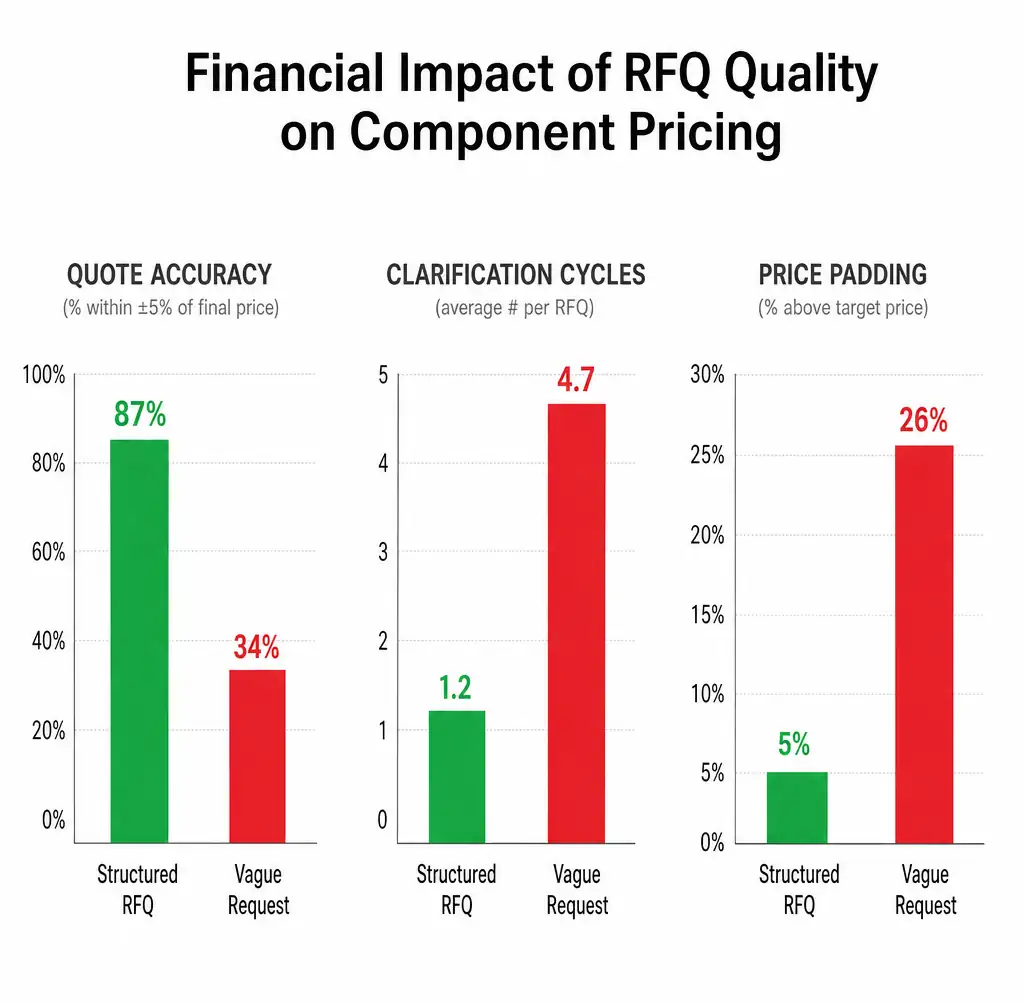 Comparaison à impact des coûts montrant les différences de prix entre les RFQ complètes et incomplètes
Des RFQ incomplètes déclenchent deux multiplicateurs de coût. Premièrement, les fournisseurs appliquent des tarifs de 15 à 30 % pour couvrir le risque d’ambiguïté — si votre demande exige un modèle automobile plutôt que commercial, ils ont fixé le prix de manière défensive. Deuxièmement, les cycles de clarification consomment de 3 à 7 jours par itération, comprimant votre fenêtre d’évaluation et forçant les décisions sous pression temporelle plutôt que sur le mérite.
Une étude de référence des achats de 2025 menée auprès de 340 fabricants d’électronique a révélé que les RFQ contenant des spécifications techniques complètes, des prévisions de volume et des exigences de qualité recevaient en moyenne des devis 23 % inférieurs aux RFQ minimales pour des composants identiques. La différence n’est pas la générosité des fournisseurs — c’est la tarification à risque. Une information complète permet aux fournisseurs de deviser en fonction des faits plutôt que des hypothèses du pire scénario.
Informations essentielles Chaque RFQ composant doit inclure {#essential-rfq-information}
Chaque RFQ composant nécessite six catégories d’information. En manquer ne serait-ce qu’un seul oblige les fournisseurs à soit refuser le devis, soit à estimer de manière prudente, aucun des deux résultats ne servant vos objectifs d’approvisionnement.
Contexte de l’entreprise et du projet
Les fournisseurs doivent comprendre qui vous êtes et ce que vous construisez. Incluez le nom de votre entreprise, votre secteur d’activité et le type de candidature. Un fabricant de dispositifs médicaux reçoit des recommandations de composants différentes de celles d’une start-up IoT grand public, même pour des exigences fonctionnellement similaires. Mentionner « système radar automobile » versus « nœud capteur industriel » change les composants recommandés par les fournisseurs et les certifications qu’ils valident.
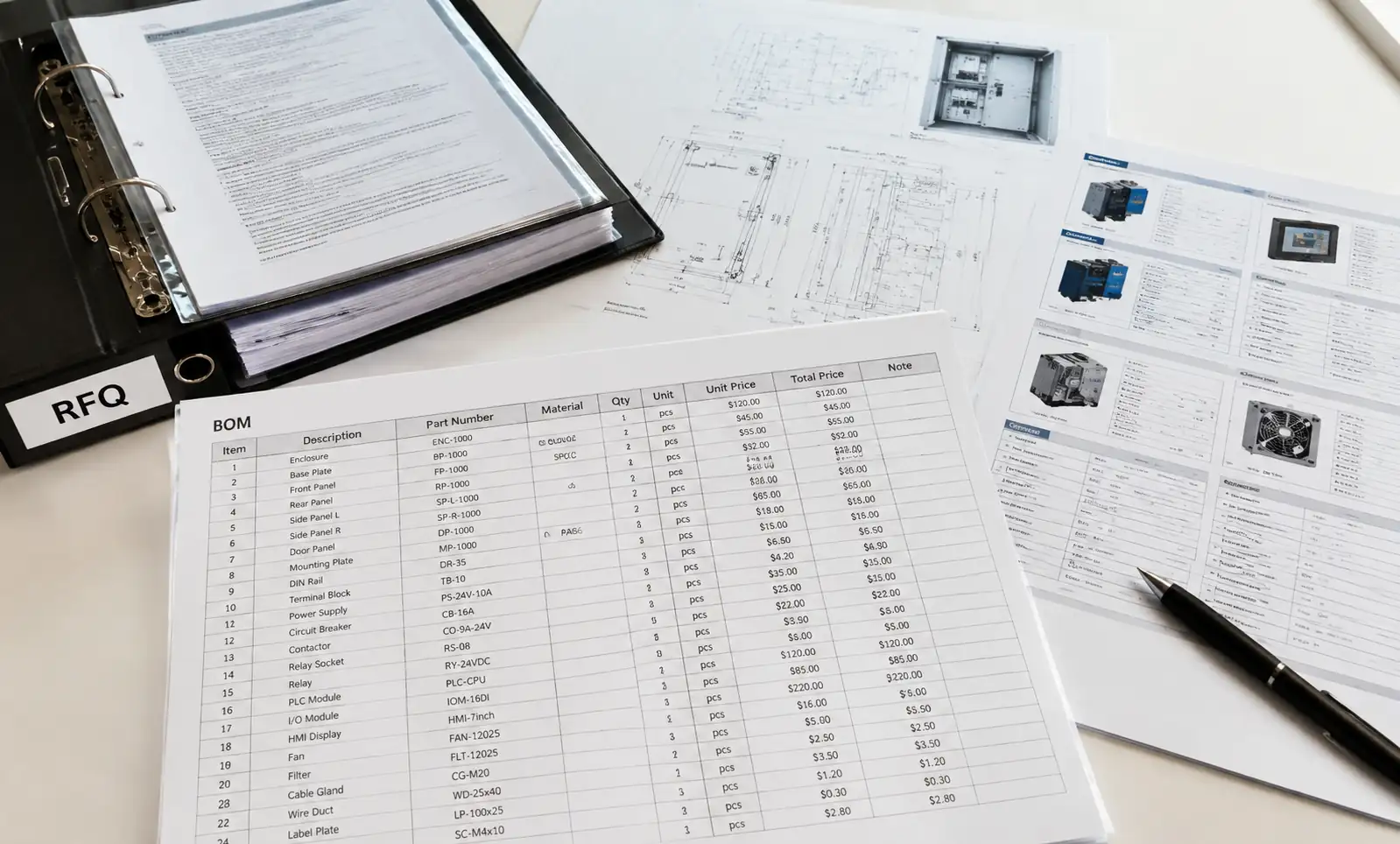 Dossier complet de documentation RFQ incluant un tableau de départ et des spécifications techniques
Format de la Facture (BOM)
Structurez votre liste de matériaux sous forme de tableau vierge avec au minimum ces colonnes : numéro d’article, numéro de pièce du fabricant (MPN), nom du fabricant, description, quantité par assemblage, quantité totale requise, désignateurs de référence et alternatives acceptables. Ajoutez des colonnes pour les besoins d’emballage (ruban coupé, bobine complète, plateau), statut sans plomb/RoHS, et toute restriction de code de date.
| Champ BOM obligatoire | But | Exemple |
|---|---|---|
| Numéro d’article | Référence de suivi pour les citations | 1, 2, 3... |
| Numéro de pièce du fabricant | Identité exacte des composantes | TPS54620RHLR |
| Nom du fabricant | Élimine l’ambiguïté | Texas Instruments |
| Description | Résumé lisible par l’humain | Convertisseur abaisseur 6A, entrée 17V |
| Quantité par assemblage | Utilisation des unités | 2 |
| Quantité totale | Volume d’achat | 10 000 |
| Désignateurs de référence | Emplacement du PCB | U5, U12 |
| Alternatives acceptables | Flexibilité pour l’approvisionnement | TPS54622RHLR, LM53603RQKR |
Les cartes de bord propres éliminent 80 % des questions de clarification. Utilisez des noms de fabricants cohérents (pas « TI » sur une ligne et « Texas Instruments » dans une autre), validez tous les numéros de pièce par rapport aux fiches techniques du fabricant, et supprimez toute cellule fusionnée ou formatage complexe qui casse lorsque les fournisseurs importent votre fichier.
Exigences de qualité et de conformité
Énoncez toutes les certifications, normes ou exigences de conformité dès le départ. Cela inclut la conformité RoHS/REACH, la déclaration des minerais de conflit, les qualifications automobiles (AEC-Q100/Q200), les notes de température (commerciale/industrielle/automobile/militaire), les contraintes de sensibilité à l’humidité (MSL), ainsi que toute exigence spécifique au client comme la documentation PPAP ou l’inspection du premier article.
Les exigences de qualité affectent considérablement l’approvisionnement. Un microcontrôleur de qualité commerciale coûte 2,80 $ ; Le coin identique dans un pack certifié automobile coûte 6,40 $. Indiquer « application automobile » sans préciser si vous avez besoin de pièces certifiées AEC-Q100 ou si des pièces de qualité commerciale suffit fait perdre du temps à tout le monde.
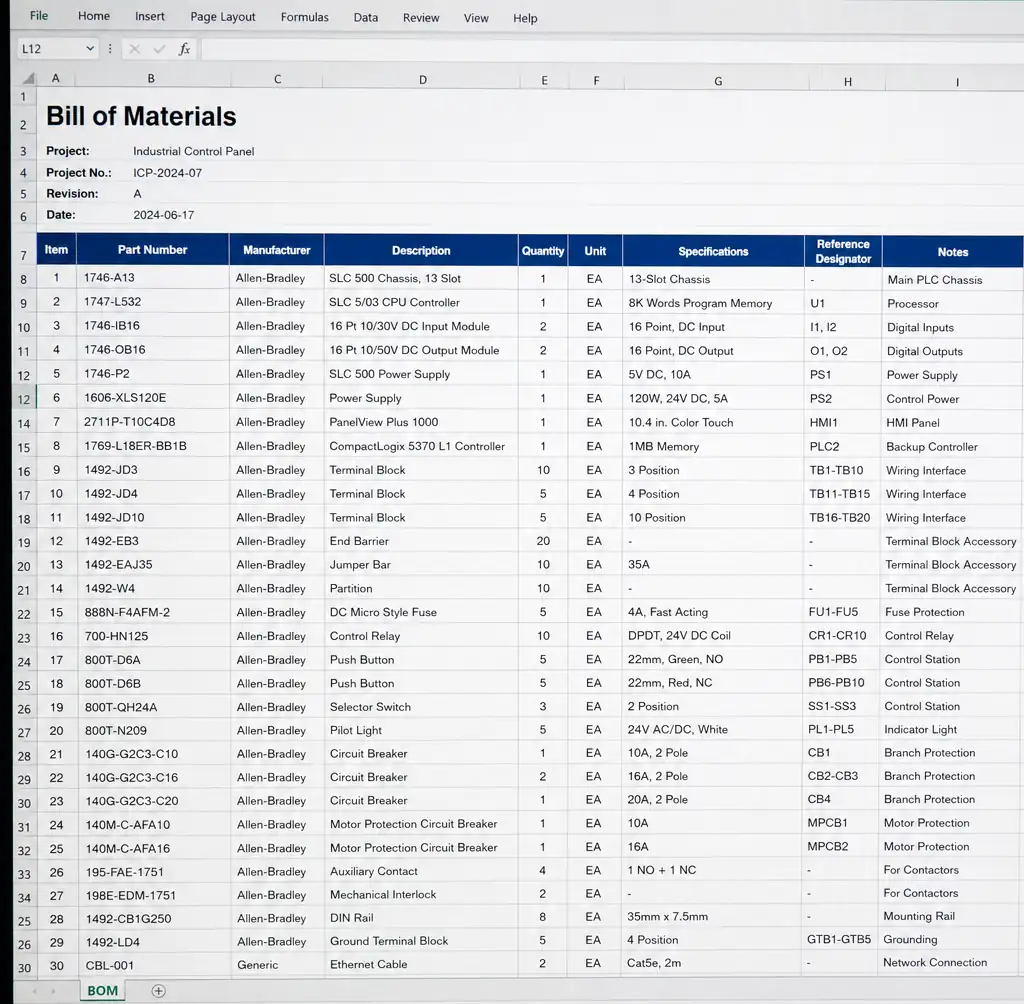 Feuille de tableau de base propre montrant la mise en forme correcte des numéros de pièce et les spécifications des composants
Précision et vérification du numéro de pièce
Chaque numéro de pièce doit être vérifié par rapport au catalogue actuel du fabricant. Utilisez les outils de recherche de numéros de pièce du fabricant ou les sites web des distributeurs autorisés pour confirmer des chaînes exactes, y compris les suffixes indiquant l’emballage, la température ou le niveau de qualification. Un condensateur Murata GRM188R71C104KA01D ne diffère du GRM188R71C104KA01J que par l’emballage (D = bobine de 7 pouces, J = bobine de 13 pouces), mais commander le mauvais condensateur affecte la planification de la production.
Lors de la spécification des circuits intégrés, incluez le code de commande complet avec le boîtier, la qualité de température et la désignation bande et bobine. Pour un microcontrôleur, « STM32F407VGT6 » est incomplet — le code de commande complet « STM32F407VGT6TR » précise le boîtier LQFP100, le grade industriel de -40°C à +85°C, et l’emballage bande et bobines. Ces détails déterminent la disponibilité et les prix.
Statut du cycle de vie et risque d’obsolescence
Vérifiez l’état du cycle de vie des composants avant de soumettre des appels d’offres (RFQ). Les composants marqués « non recommandés pour les nouveaux designs » ou « en fin de vie » créent un risque pour la chaîne d’approvisionnement, quelle que soit leur disponibilité actuelle. Les fournisseurs apprécient quand vous reconnaissez le risque d’obsolescence — cela montre que vous êtes conscient et prêt à discuter d’alternatives si nécessaire.
Les désignateurs de référence aident les fournisseurs à comprendre le contexte du circuit et à identifier les opportunités de consolidation ou d’optimisation. Lorsque toutes les résistances étiquetées R1-R8, R15-R22 et R44-R51 ont des spécifications identiques (10kΩ, 1 %, 0603), le fournisseur peut suggérer de passer à une taille de bobine plus grande pour plus d’économies.
| Niveau de qualité des BOM | Réponse typique des fournisseurs | Retournement de citations |
|---|---|---|
| MPN propre, chiffres vérifiés, spécifications complètes | Devis comme demandé, suggestions d’optimisation possibles | 24-48 heures |
| MPN avec des erreurs mineures, intention claire | Demande de clarification, tente quand même de citer | 48-72 heures |
| Descriptions génériques, pas de MPN | Demandez toutes les informations avant de faire un devis | 5-7 jours |
| Précision mitigée, pièces obsolètes | Besoin d’un appel de clarification, suggestion de refonte | 7+ jours |
Spécifications de volume et de délai de livraison qui obtiennent un prix réel
La tarification des composants suit des seuils liés à l’économie de l’emballage et de la fabrication. Demander un devis pour « 1 000 pièces » produit un prix différent de celui de « 1 000 pièces commande initiale, 2 500 pièces mensuelles par la suite pendant 18 mois, volume total du programme 46 000 pièces. »
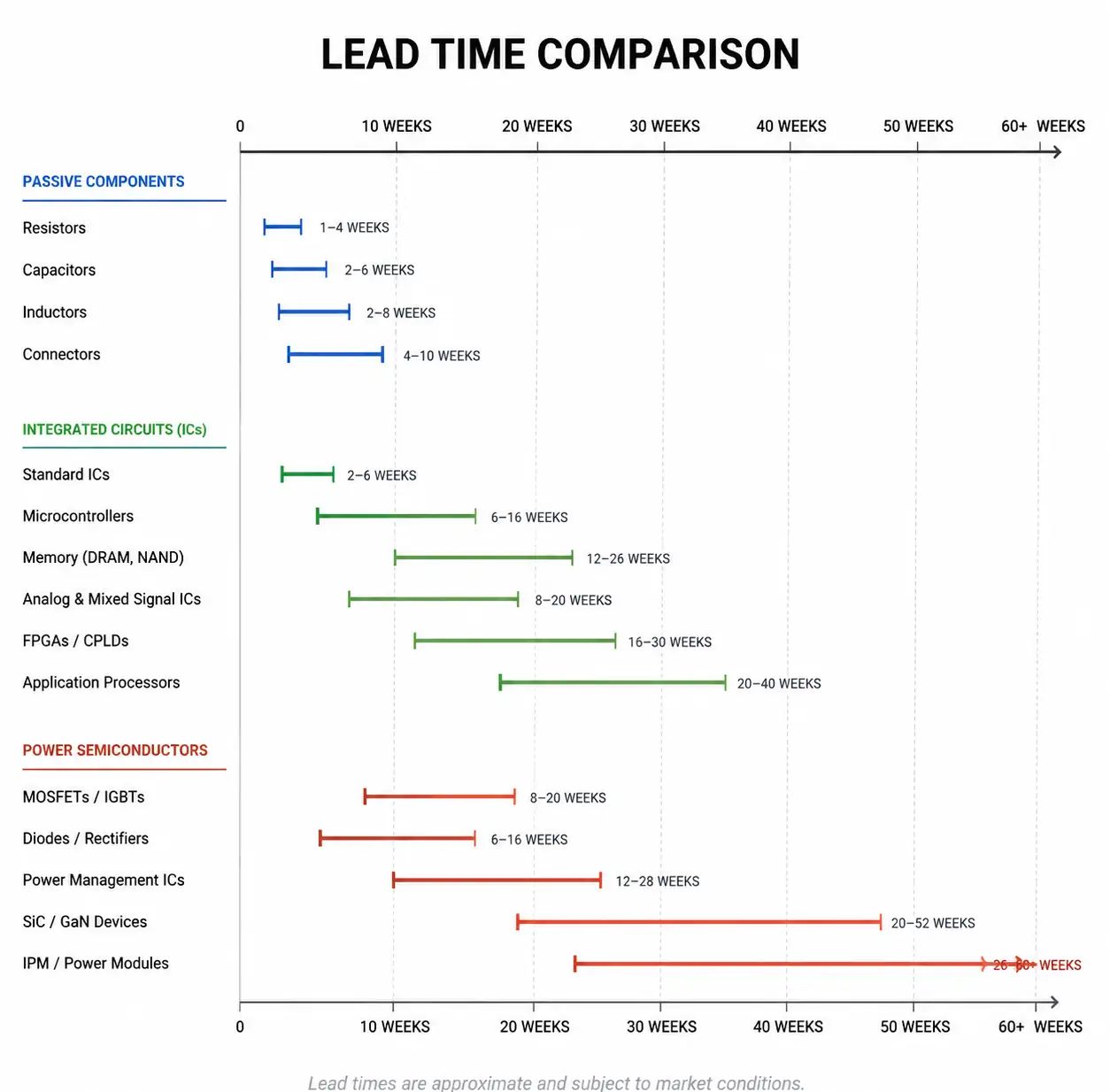 Chronologie visuelle montrant les délais de livraison des composants électroniques dans différentes catégories
Réalisme et flexibilité du délai de livraison
Indiquez la date de livraison souhaitée et précisez la flexibilité. « Obligatoire en entreprise avant le 10 avril 2026 » diffère de « Obligatoire en interne avant le 10 avril 2026 ; peut accepter un envoi partiel de 60 % d’ici le 10 avril et le reste d’ici le 24 avril si le coût est réduit. » La seconde approche permet souvent de débloquer de meilleurs prix car elle offre aux fournisseurs des options pour gérer eux-mêmes leurs contraintes de chaîne d’approvisionnement.
Les délais actuels pour les composants électroniques sont en moyenne de 16 à 24 semaines selon la catégorie, certaines pièces spécialisées allant de 30 à 40 semaines. Demander des devis avec des délais de deux semaines indique un manque d’expérience, à moins d’être prêt à payer des frais d’accélération allant de 15 à 50 % du coût des composants.
| Catégorie de composants | Délai d’exécution typique (2026) | Options à court court | Premium pour Accéléré |
|---|---|---|---|
| Passives standard (résistances, condensateurs) | 8-12 semaines | Stock distributeur : 1-2 semaines | 10-20 % |
| CI courants (amplificateurs opérationnels, régulateurs, MCU) | 12-16 semaines | Stock distributeur : 1-3 semaines | 15-30 % |
| Semi-conducteurs de puissance (MOSFET, IGBT) | 16-24 semaines | Disponibilité limitée des stocks | 20-40 % |
| CI spécialisés/attribués | 24-40 semaines | Court-plomb rarement disponible | 30-50 %+ |
Normes de qualité et exigences de conformité
Les spécifications de qualité influencent à la fois le coût des composants et la sélection des fournisseurs. Considérer tous les niveaux de qualité comme équivalents crée un risque de production ; Surspécifier la qualité gaspille un budget sur une capacité dont vous n’avez pas besoin.
Emballage des composants électroniques montrant des certifications de qualité et des marquages de conformité
Températures et environnement d’application
Les composants sont livrés en quatre catégories de température avec des implications coûteuses importantes. De qualité commerciale (0°C à +70°C) sert les produits de consommation intérieure. Le grade industriel (-40°C à +85°C) gère la plupart des applications commerciales et industrielles. La qualité automobile (-40°C à +125°C ou +150°C) concerne les environnements automobiles sous le capot et les environnements industriels difficiles. Le grade militaire (-55°C à +125°C) sert l’aérospatiale et la défense.
Le multiplicateur de coût entre la qualité commerciale et automobile varie de 1,5x à 3,5x selon le type de composant. Si votre produit fonctionne dans un environnement intérieur contrôlé, spécifier des composants de qualité automobile est un gaspillage budgétaire sans améliorer la fiabilité.
Prévention de la contrefaçon et sécurité de la chaîne d’approvisionnement
Pour les applications critiques, spécifiez uniquement les sources autorisées du distributeur — pas de composants du marché gris ni de courtiers. Cette exigence coûte 8 à 15 % de plus mais élimine le risque de contrefaçon. Si les sources de courtier sont acceptées pour les composants non critiques, indiquer quels éléments permettent cela et lesquels ne nécessitent que des canaux autorisés.
Demandez les rapports d’examen et les certifications dès le départ si votre candidature l’exige. Indiquer « exigera des rapports d’analyse XRF pour tous les CI » et « nécessitera des données de test paramétriques spécifiques au lot pour les semi-conducteurs de puissance » permet que les fournisseurs prennent en compte le coût des tests dans les devis plutôt que de découvrir cette attente lors de l’exécution du contrat.
Erreurs courantes de RFQ qui gonflent les coûts
Huit erreurs récurrentes créent un impact évitable sur les coûts et les calendriers. Reconnaître ces motifs dans votre propre processus de RFQ permet d’économiser des itérations.
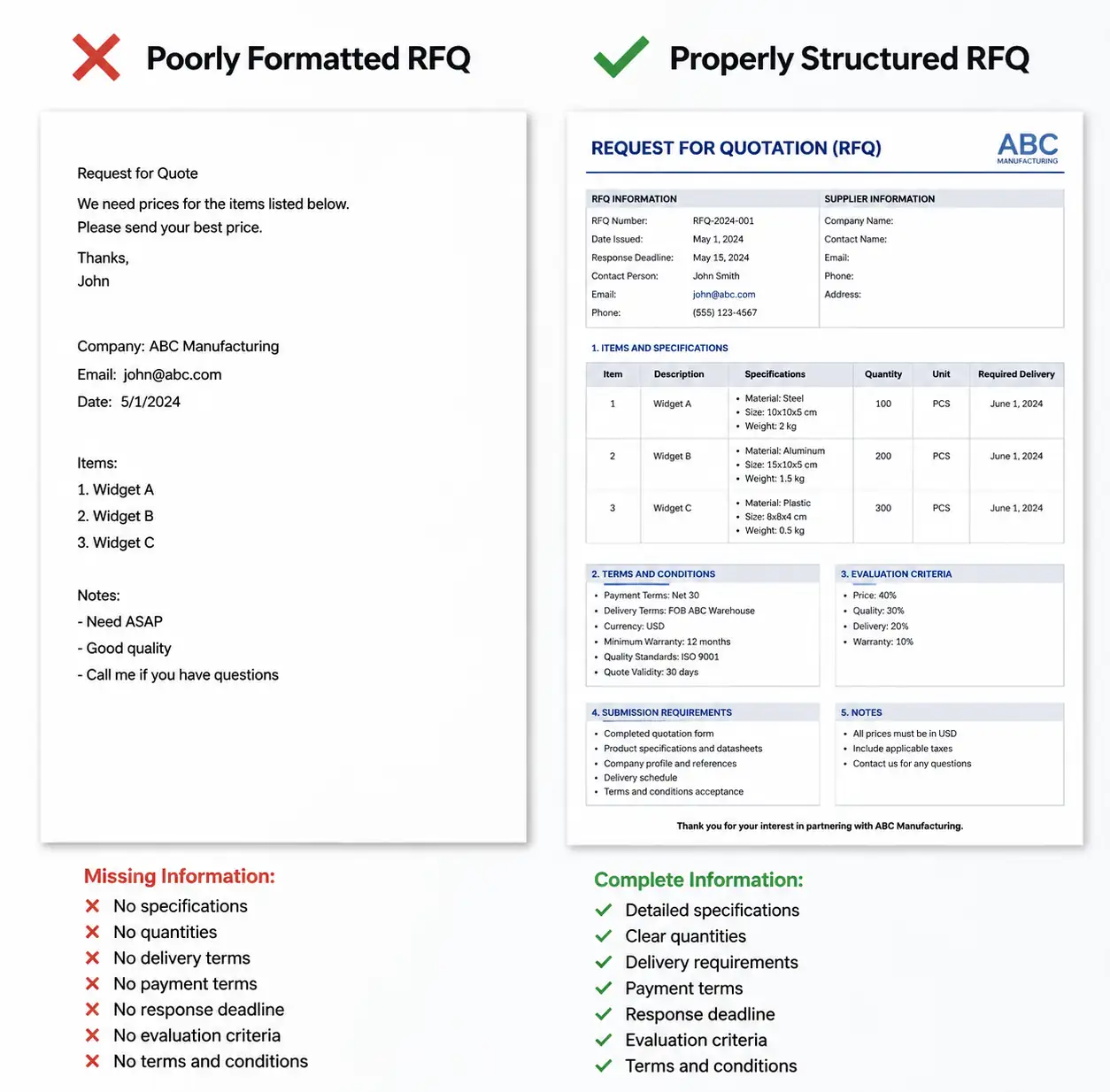 Comparaison côte à côte montrant une mise en forme RFQ incorrecte versus correcte
Omission de la documentation clé
Les fournisseurs font des devis plus précis grâce à l’accès à des schémas, des fichiers de mise en page et des dessins mécaniques. Pour les devis d’assemblage de PCB, la retenue des fichiers Gerber oblige les fournisseurs à estimer l’utilisation des panneaux, les exigences en outillages et la complexité de l’assemblage — estimant que le coût de la plateforme est de 20 à 35 %. Fournir une documentation complète permet de fournir des devis plus serrés et de réduire les surprises post-attribution.
Les questions de configuration se résolvent plus rapidement avec les plans. Si vous demandez des devis pour un connecteur personnalisé, un dessin dimensionné montrant l’interface d’accouplement, le pas de broche, la capacité de courant par contact et les exigences de rétention mécanique répond aux questions avant qu’elles ne soient posées. Les échanges d’emails confirmant ces détails prennent 2 à 4 jours par cycle.
Incapacité à identifier des alternatives acceptables
Les stratégies à composant à source unique créent une fragilité dans la chaîne d’approvisionnement. Si votre conception n’accepte qu’un seul numéro de pièce fabricant spécifique sans alternative, précisez-le explicitement — mais reconnaissez que cela vous coûtera à la fois en termes de levier tarifaire et de risque de disponibilité. Les fournisseurs confrontés à des exigences de la seule source font des devis prudents car ils n’ont aucune flexibilité pour optimiser l’approvisionnement.
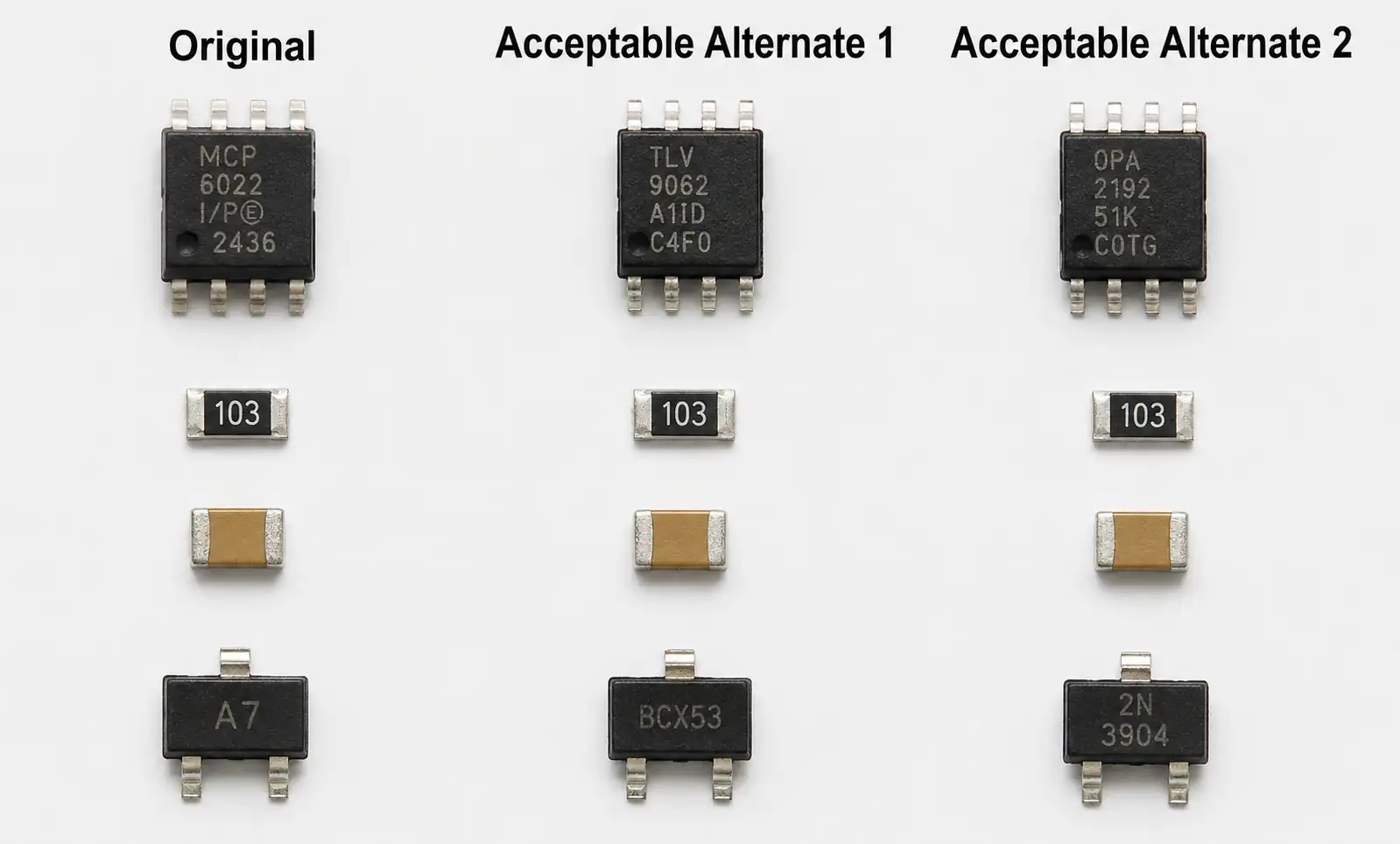
Lorsque les alternatives sont acceptables, définissez précisément les critères d’équivalence. « Forme, ajustement, fonction compatible » varie selon l’interprétation. La pièce « compatible » d’un fournisseur peut correspondre au brochage mais avoir un courant d’arrêt différent, une réponse transitoire de charge différente ou une polarité activée. Des critères explicites empêchent les substitutions inappropriées : « Les alternatives acceptables doivent correspondre à l’empreinte d’origine dans une peine de 0,1 mm, des paramètres électriques à ±5 %, polarité et synchronisation identiques de la broche de contrôle, courant de repos équivalent ou plus faible. »
Composants électroniques montrant des pièces alternatives originales et acceptables avec des spécifications
Demande de devis auprès de fournisseurs non qualifiés
Diffuser des RFQ à chaque fournisseur potentiel fait perdre votre temps d’évaluation et les ressources de devis des fournisseurs. Qualifiez les fournisseurs avant de demander des devis. Est-ce qu’ils gèrent ta plage de volume ? Servent-ils votre secteur d’industrie ? Conservent-ils les certifications requises par votre candidature ?
Un distributeur spécialisé dans les quantités prototypes (1 à 100 pièces) ne peut pas servir efficacement des programmes de production nécessitant 50 000 pièces trimestrielles. Un fabricant axé sur le volume ne peut pas répondre économiquement aux besoins de faible volume et à forte diversité comme les constructeurs d’équipements industriels sont typiques. Ciblez les fournisseurs dont le modèle économique correspond à votre profil d’approvisionnement.
FAQ
Quelle est la différence entre RFQ, RFP et RFI ?
Une RFQ (Demande de devis) demande aux fournisseurs de fournir des prix pour des composants ou services spécifiquement définis. Tu sais déjà ce dont tu as besoin ; Vous comparez fournisseurs et tarifs. Un appel d’offres (RFP) invite les fournisseurs à proposer des solutions lorsque les exigences sont moins définies — vous connaissez le problème mais souhaitez des recommandations des fournisseurs sur l’approche. Une RFI (Demande d’Information) recueille des informations générales sur les capacités des fournisseurs avant le début officiel des achats. Pour l’acquisition de composants, la RFQ est l’outil approprié lorsque vous disposez d’une liste de matériaux complète.
À combien de fournisseurs dois-je demander des devis ?
Trois à cinq fournisseurs qualifiés offrent une concurrence suffisante tout en maintenant l’évaluation gérable. Demander des devis à dix fournisseurs ou plus fait perdre du temps d’évaluation sans améliorer les résultats — la pression de la concurrence des prix atteint après quatre fournisseurs. Privilégiez la qualité des fournisseurs plutôt que la quantité. Deux fournisseurs hautement qualifiés et expérimentés produisent souvent de meilleurs résultats que sept fournisseurs à peine qualifiés.
Que dois-je faire si tous les devis dépassent mon budget ?
D’abord, vérifiez que vos spécifications correspondent aux exigences réelles — la surestimation (qualité automobile pour applications non automobiles, tolérances strictes inutiles pour le fonctionnement) gonfle le coût sans bénéfice. Deuxièmement, discutez des engagements de volume — les fournisseurs débloquent souvent de meilleurs fourchettes tarifaires pour des volumes de prévisions engagés. Troisièmement, explorez l’ingénierie de la valeur — les fournisseurs peuvent recommander des composants alternatifs ou des options d’emballage répondant aux exigences à moindre coût. Enfin, évaluez si la flexibilité des délais aide — des délais plus longs réduisent parfois les primes d’accélération.
Comment gérer les composants obsolètes dans ma liste de cartes (BOM) ?
Vérifiez le statut du cycle de vie avant de demander des devis via les sites web des fabricants ou les outils distributeurs autorisés. Si les composants indiquent « non recommandé pour les nouveaux designs » ou « fin de vie », identifiez de manière proactive les remplacements acceptables et incluez-les dans votre appel d’offres. Les fournisseurs apprécient que vous reconnaissiez l’obsolescence — cela montre que vous êtes informé et ouvert aux recommandations. Pour les conceptions héritées critiques, renseignez-vous sur les opportunités d’achat de dernière fois et les programmes d’inventaire en consignation.
Quelles informations ne devrais-je jamais inclure dans une demande de renseignements ?
Évitez de divulguer des informations de conception propriétaires au-delà de ce qui est nécessaire pour le devis. Ne partagez pas les schémas complets lorsque le contexte partiel du circuit suffit. Ne divulguez pas les noms confidentiels des clients sauf si cela est requis pour la vérification de la certification. Ne révélez pas votre budget maximal — il devient le plancher pour les devis. Ne partagez pas les détails de prix compétitifs qui violent la confidentialité. Fournissez des spécifications techniques complètes, des prévisions de volume claires et des exigences de calendrier honnêtes.
Conclusion
Des RFQ efficaces éliminent l’itération en fournissant des spécifications complètes, des prévisions de volume réalistes, des exigences de qualité claires et des délais explicites à l’avance. La différence entre un cycle de devis de trois jours et un processus de clarification de trois semaines réside dans la complétude des informations, pas dans la réactivité du fournisseur. Les professionnels des achats qui consacrent trente minutes à structurer une RFQ complète économisent des semaines en corrections, négociations et ordres de modification en aval.
Lorsque votre cycle d’approvisionnement nécessite des composants vérifiés, des processus de RFQ simplifiés et une transparence de la chaîne d’approvisionnement, les services d’approvisionnement de Hitop Tech Limited fournissent l’infrastructure et les relations fournisseurs qui transforment des RFQ précises en approvisionnement fiable en composants.